

Examine why technically sound food-safety systems can still fail because of human decision-making, communication, workload, competence and escalation behavior and how organizations can design systems that make the right action easier than the wrong action.
Our HACCP plans are validated, our CCPs monitored, our SOPs controlled. So why do the same deviations keep landing on the same desks? Because the last variable in every process is a person — and most systems are still designed as if that weren’t true.
By Atique Rehman, MSc, MSQA, CQP-MCQI, CSSBB, CMQ/OE
Walk any plant with a mature food safety management system and you will usually find the paperwork in order. The hazard analysis is current, critical limits are validated, verification records are signed. And still the deviations come, an allergen changeover missed at line speed, a temperature transposed on a log, a hold that should have been called and was not. We open the investigation and the finding writes itself: human error. Retrain the operator, close the CAPA, move on.
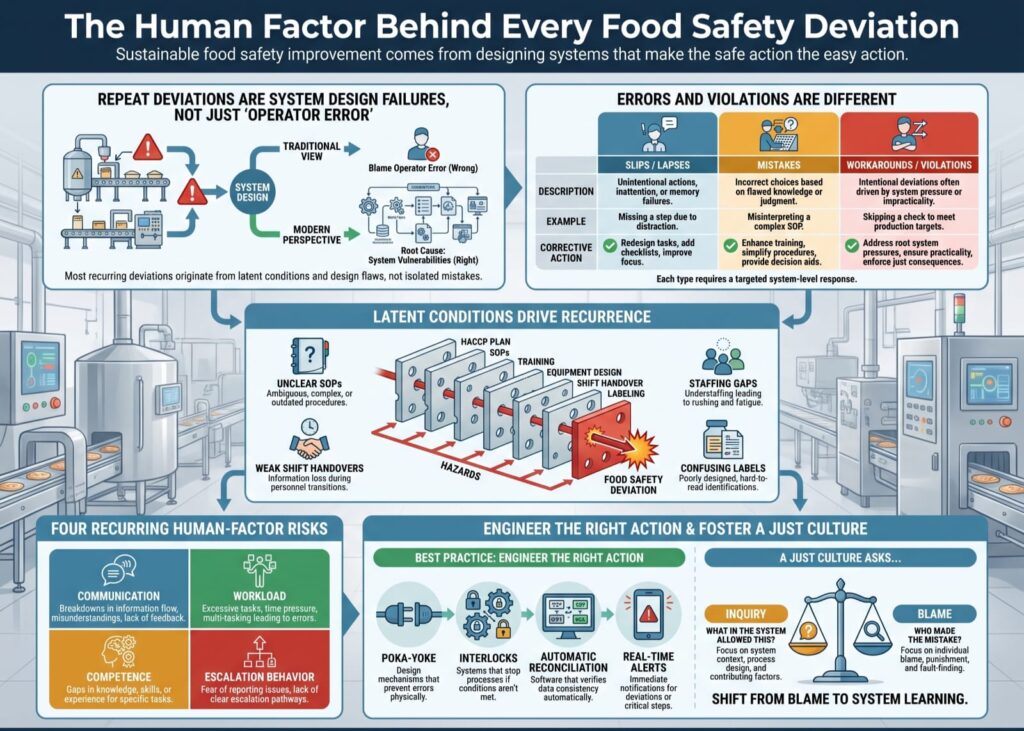
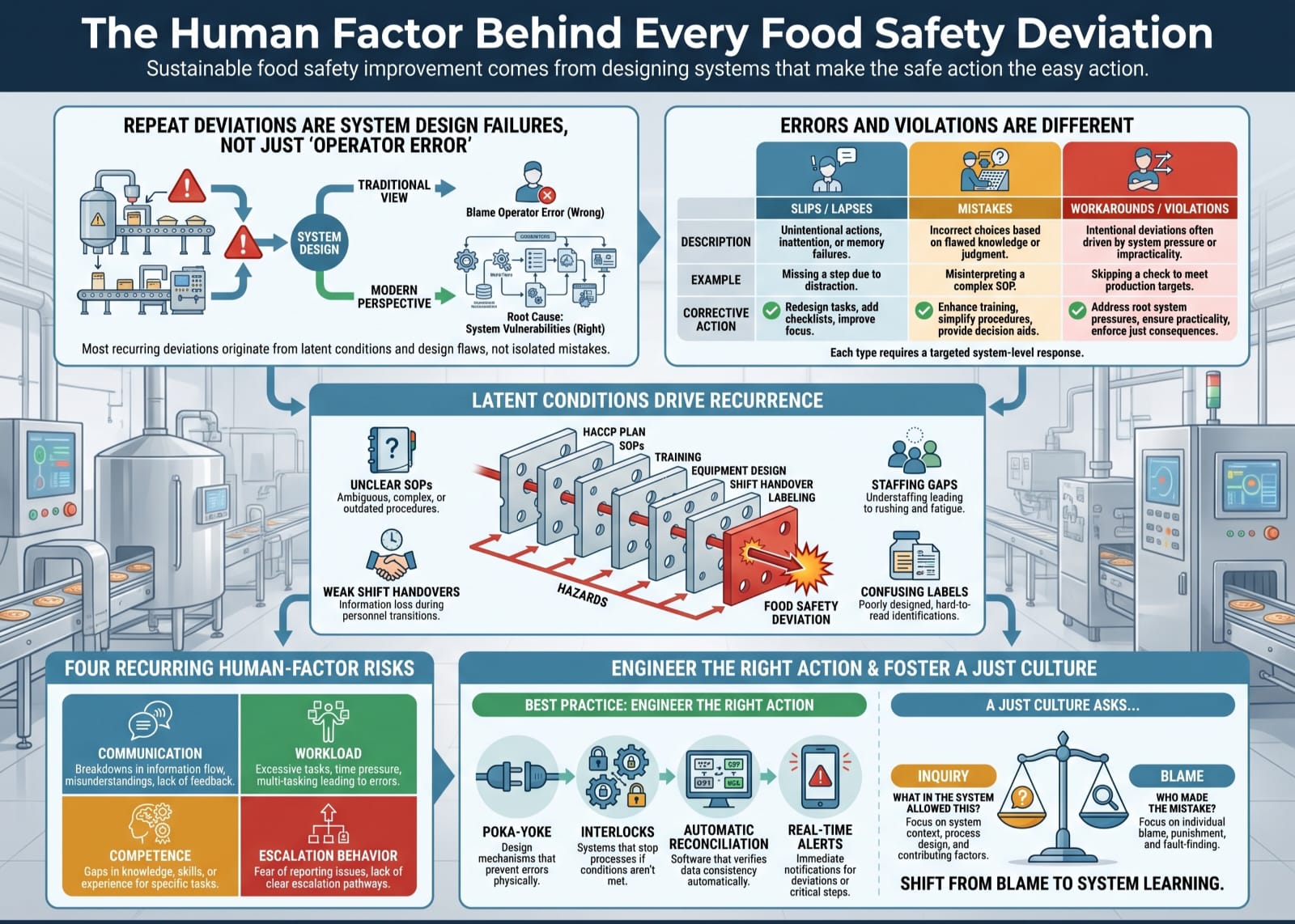
That finding is almost always wrong, and it is worth being blunt about why. In most cases what we label human error is the visible end of deeper systemic conditions, unclear procedures, poor task design, and missing controls. When a trained operator, following documented SOPs, in a facility with a validated system, still produces a nonconformance, the procedure, the training, the workspace or the environment is nearly always a contributing factor. Isolating the individual and treating the system as passive background ignores most of what happened and it does not prevent recurrence. Leave the ambiguous label, the overcrowded station and the undocumented shift handover in place, and a different person makes the same mistake next month. The corrective action looks like action while changing nothing.
What we actually mean by “human error”
James Reason gave us the working vocabulary decades ago, and it still is not used enough on the floor. He separated errors from violations. Errors are unintended: slips and lapses, skill-based actions that fail under fatigue, distraction or interruption (you meant to hit one button and hit the next; you knew the step and forgot it) and mistakes, where the plan itself is flawed because of a knowledge or training gap.
Violations are different in kind: deliberate departures from a rule, most often because the rule collides with the reality of getting the job done.
The distinction matters because each demands a different remedy. Slips and lapses respond to better conditions, shorter runs between checks, fewer interruptions, clearer layouts not to another round of retraining. Mistakes need genuine competence and decision support. Violations require the uncomfortable question: why was the compliant path the harder path?
“Rather than being the main instigators of an accident, operators tend to be the inheritors of system defects … adding the final garnish to a lethal brew whose ingredients have long been in the cooking.”
James Reason, Human Error (1990)
Reason’s larger contribution was the Swiss cheese model: hazards are stopped by successive layers of defense, each riddled with holes, and harm occurs only when the holes momentarily align. The operator at the sharp end is usually the last person in a long chain, not the first cause. The dangerous holes are the latent conditions, an unworkable procedure, a chronic staffing gap, a label design that invites confusion that sit dormant until the day everything lines up.
The conditions that manufacture deviations
Four human variables show up again and again when you read deviation trend data honestly rather than incident by incident.
Communication. The shift change handover with no formal documentation is one of the most reliable hole generators in any plant. What one crew knew, the next never received and the record shows a compliant handover that never really happened.
Workload. Sustained attention on repetitive tasks degrades after roughly 20–30 minutes, and error probability climbs with fatigue, distraction and interruption. High volume repetitive work guarantees eventual error through pure probability. That is a design fact, not a motivation problem and no amount of “pay attention” repeals it.
Competence. Not “was she trained,” but does she understand the why behind the control. When people grasp what actually happens when a CCP is skipped, they escalate a concern before it becomes an event.
Escalation behavior. This is the one that separates mature operations. The useful question is not “was the issue reported” but what it took for someone to raise it and whether that happened before or after a near miss. Where speaking up is safe, deviations surface as weak signals; where it isn’t, they surface as recalls.
Make the right action easier than the wrong one
The shift the best operations have made is to stop relying on human vigilance and start engineering the decision. Error-proofing poka-yoke, begins by accepting that skilled people will eventually err, and designs the work so the error cannot become a defect. In food terms that means asymmetric or coded fittings that only connect the correct way, scale interlocked weighing that will not advance on a wrong quantity, label systems that reconcile automatically at changeover, and data logged CCPs that flag an excursion in real time instead of at end-of-shift review. Make the wrong action physically harder ideally impossible than the right one.
The controls only hold inside a culture that supports them. GFSI’s 2026 position paper (A Culture of Food Safety, v2.0) reframes food safety culture as an integrated system of shared values, behaviors, risk awareness and organizational learning measurable, actionable, and inseparable from your formal HACCP and FSMS rather than a poster in the break room. The FDA put the stakes plainly in its New Era of Smarter Food Safety: we will not meaningfully reduce foodborne illness “without doing more to influence and change human behavior.”
Practically, that means a just culture stance in every investigation, Reason’s own prescription where the first question is what about the system allowed this, not who did it. A blame response teaches people to hide deviations until they are expensive; a learning response teaches them to surface the latent condition while it is still cheap to fix.
None of this lowers the bar on technical rigor. The hazard analysis still has to be right; the critical limit still has to hold. But the next order of gains in food safety will not come from a tighter limit. It will come from treating the human factor as an engineering discipline reading deviation data for the workload, communication and escalation patterns underneath it, and building work where doing the job right and doing it safely are the same motion. The deviation was never really the operator’s. It was ours, in how we designed the work.