

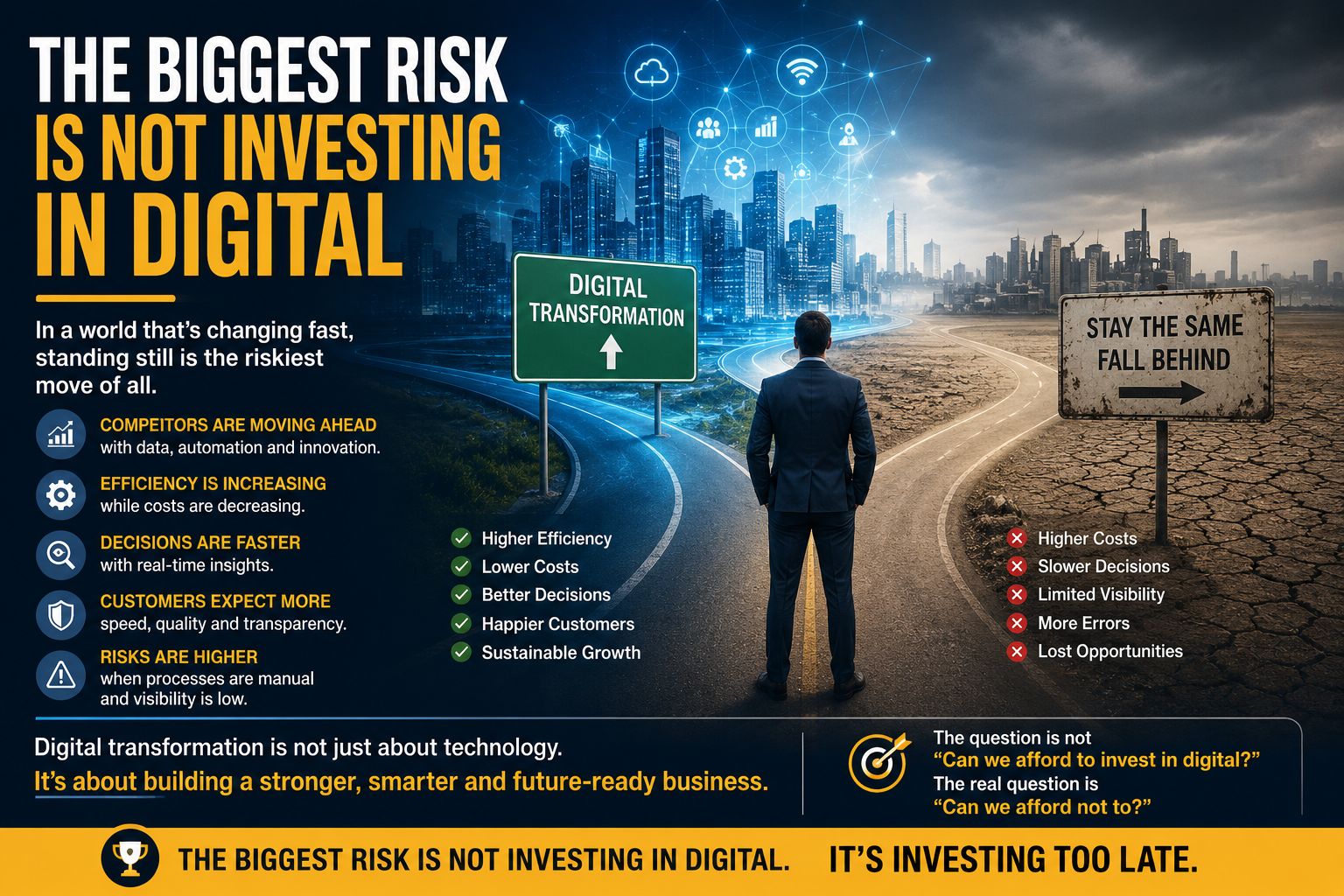

Technology is changing manufacturing at an unprecedented pace. Businesses that embrace digital transformation will become more efficient, more agile and better prepared for future challenges. Those that delay will find it increasingly difficult to compete.
For many years, manufacturers measured their strength by the size of their factories, the speed of their production lines and the value of their equipment. Today, another asset has become just as important—the digital foundation that connects people, processes and data.
The real risk facing manufacturers is no longer whether they can afford to invest in digital technology. The bigger question is whether they can afford not to.
A digital foundation is not about buying the latest software or following the newest technology trend. It is about ensuring that accurate information is available to the right people at the right time. When production, quality, maintenance, warehousing and planning are connected, decisions become faster, more consistent and based on facts rather than assumptions.
Yet many factories still rely on paper records, spreadsheets and disconnected systems. Operators record data manually, supervisors spend hours preparing reports and managers make decisions using yesterday’s information. By the time problems become visible, they have often already affected quality, productivity or customer satisfaction.
I’ve visited factories with highly automated production lines but very little visibility of what was happening in real time. They had invested in machines but not in information. The result was unnecessary waste, avoidable downtime and slow decision-making.
The cost of delaying digital investment is rarely shown on a financial report. It appears as product losses, inefficient processes, excess labour, customer complaints, delayed traceability and missed opportunities for improvement. These hidden costs continue to grow every day a business relies on manual systems.
In today’s food industry, customers expect complete traceability, retailers demand consistency and certification bodies require reliable records. Meeting these expectations with disconnected systems is becoming increasingly difficult.
Artificial intelligence has become the latest business buzzword, but AI is only as good as the data it receives. Poor-quality or incomplete data will never produce reliable insights. Before organisations can benefit from AI, predictive analytics or smart automation, they must first build a solid digital foundation.
The good news is that digital transformation does not require a massive investment overnight. The most successful companies start with a clear vision, solve real business problems and build capability one step at a time. Small improvements made consistently often deliver far greater value than large projects with unclear objectives.
The factories that will succeed over the next decade will not simply be those with the newest equipment. They will be those that can access reliable information instantly, respond quickly to change and continuously improve using real-time data.





A really important point. Digital transformation is not simply about adopting new technology, it is about creating reliable, connected data that supports better decisions across the whole operation.
Thanks for sharing!